Insights

Many borrowers appear fully qualified when they submit their mortgage application, with stable credit profiles and low debt-to-income (DTI) ratios. However, a lot can change within the 30 to 45 days that it takes to close.  As a mortgage lender, this window presents significant risk. You never know when an applicant may be opening new credit cards, falling behind on … Read More

How Undisclosed Debt Monitoring Protects You Before and After the Closing Table

Inisghts

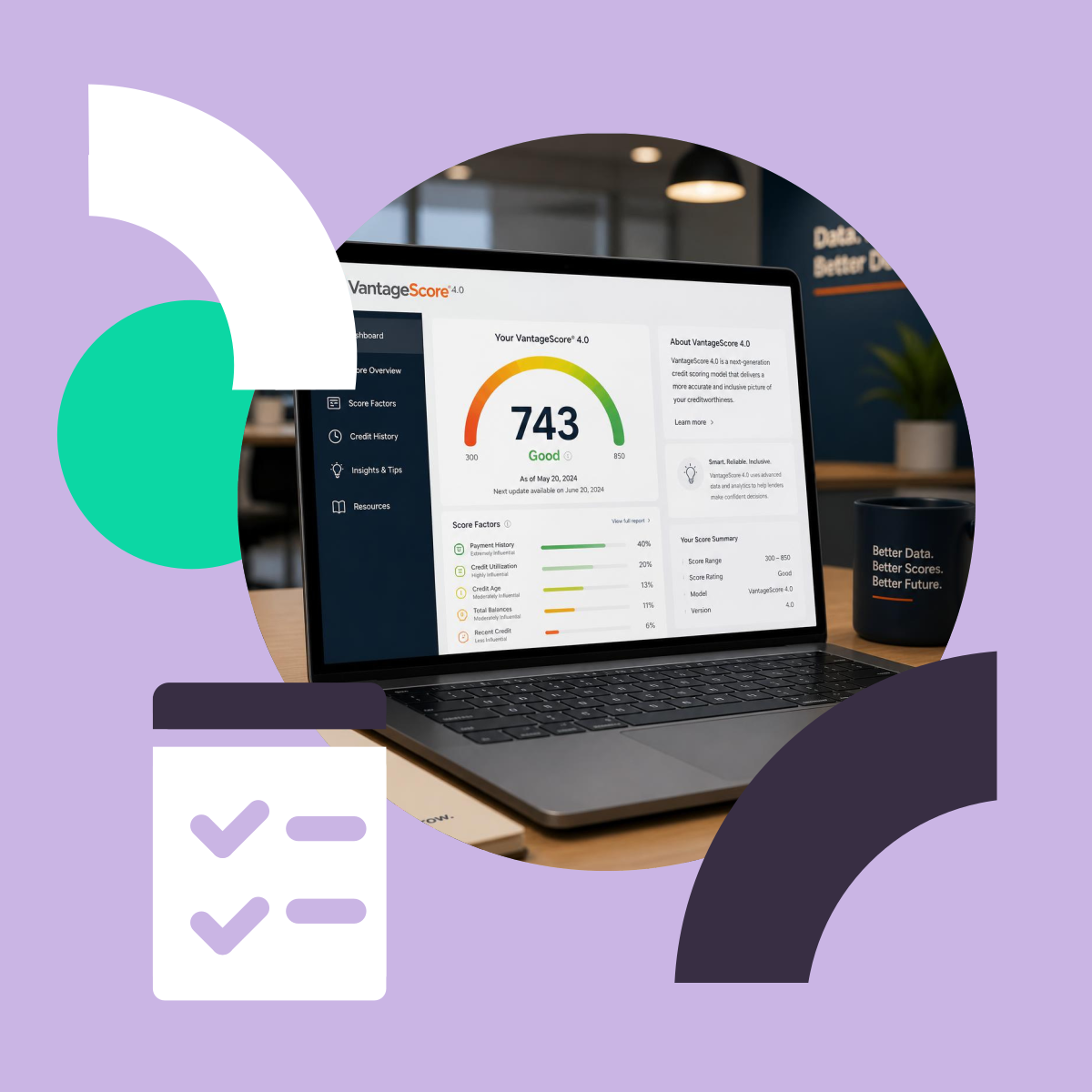
FICO and VantageScore 4.0 are now both approved credit score models for conventional mortgage loans sold to Fannie Mae and Freddie Mac. On April 22, 2026, FHFA and the GSEs announced that approved lenders may now use VantageScore 4.0 alongside Classic FICO for current Enterprise deliveries, with FICO Score 10T planned for future adoption. For mortgage loan officers, this is … Read More

FICO vs VantageScore 4.0: A 2026 Mortgage Loan Officer’s Guide to the GSE Credit Score Change

Insights

Post-closing quality control (QC) is designed to answer a critical question: Is the loan you closed the loan you thought you closed? When the answer is no, the root cause is rarely a last-minute issue. More often, it stems from verification gaps in your origination process. Post-closing errors can have significant consequences, from costly repurchase demands to increased regulatory scrutiny. … Read More

The 5 Most Common Post-Closing Errors (And the Verification Gaps Behind Them)

Insights

Most lenders know exactly where their origination pipeline stands on any given day. The loan count, the turn times, which files are stuck in underwriting. Post-closing gets a lot less attention. And that is exactly the problem, because the expensive stuff tends to show up after the loan funds: a QC audit that flags an income defect, a Fannie Mae … Read More

What Happens After the Loan Closes? A Lender’s Guide to Post-Closing Compliance

Insights

Ask most mortgage lenders what undisclosed debt monitoring is for, and the answer is usually some version of the same thing: catching borrowers who are trying to hide something. That framing is not wrong. But it is incomplete. And the gap between that framing and the full picture is exactly where pipeline risk lives. The more common and more costly … Read More

UDM Is Not Just a Fraud Tool. It Is a Pipeline Protection Strategy.

Insights

The 4506-C is a standard requirement for most loans sold to the secondary market. It is a required step for verifying borrower income through the IRS, and it sits on the critical path of nearly every loan that goes to the secondary market. That is what makes it such an effective pipeline killer. Lenders cannot skip it. They cannot rush … Read More

The 4506-C Problem: Delays, Rejections, and How to Protect Your Pipeline